From Silicon Shield to Quantum Integration: Key Takeaways from the 2026 Q2T Forum
Executive Summary
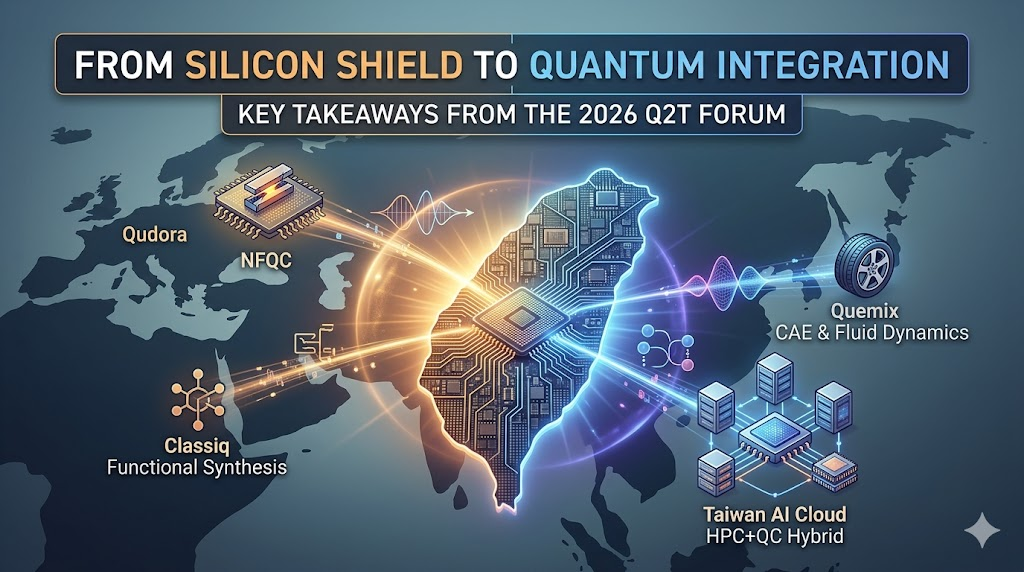
The Q2T (Quantum to Taiwan) International Advanced Forum, held on March 11, 2026, highlighted a definitive industry shift from theoretical quantum science to practical engineering and systems integration. While Taiwan leverages its semiconductor dominance to position itself as a supply chain hub, the forum showcased global advancements: Qudora's maturation of trapped-ion systems using NFQC, Classiq's move toward automated functional synthesis, and Taiwan AI Cloud's formalization of HPC+QC hybrid architectures. With industry roadmaps targeting 200-qubit systems by 2027, practical applications in quantum chemistry and fluid dynamics are entering the testing phase.
The Evolution of the Silicon Shield
Taiwan's "Silicon Shield" is expanding. At the recent Q2T forum hosted by the Institute for Information Industry, the narrative was clear: quantum computing is transitioning out of academic labs and into industrial R&D. As classical computing approaches the physical limits of Moore’s Law, a decentralized international supply chain is forming—combining Taiwan’s manufacturing capabilities, Japan’s materials science, Germany’s hardware precision, and Israel’s software architecture.
Quantum as an 'Accelerator', Not a Replacement
A persistent misconception is that quantum computers will render classical supercomputers obsolete. Peter Wu from Taiwan AI Cloud (a high-performance computing spinoff supported by ASUS) effectively dismissed this, positioning the Quantum Processing Unit (QPU) as a specialized accelerator within existing HPC frameworks—analogous to how GPUs handle parallel tasks for AI. This hybrid architecture ensures that QPUs tackle exponentially complex problems while relying on classical systems for error mitigation, noise management, and overall system control.
A persistent misconception is that quantum computers will render classical supercomputers obsolete. Peter Wu from Taiwan AI Cloud (a high-performance computing spinoff supported by ASUS) effectively dismissed this, positioning the Quantum Processing Unit (QPU) as a specialized accelerator within existing HPC frameworks—analogous to how GPUs handle parallel tasks for AI. This hybrid architecture ensures that QPUs tackle exponentially complex problems while relying on classical systems for error mitigation, noise management, and overall system control.
Hardware Scaling: The Microwave Advantage in Trapped Ions
Scaling qubit counts in trapped-ion systems has traditionally been limited by the optical complexity of laser controls. Dr. Amado Bautista-Salvador, CEO of Qudora, presented a compelling pivot toward Near-Field Quantum Control (NFQC). By utilizing microwaves instead of lasers to manipulate trapped ions, Qudora aligns quantum hardware with standard semiconductor microfabrication.
By integrating microwave antennas directly onto chips, Qudora bypasses the spontaneous emission errors inherent in laser systems, achieving coherence times of up to 60 seconds. They are currently building a 50-qubit system for the German Aerospace Center (DLR), slated for early 2027. However, viewing this from my perspective working with superconducting qubits, a critical question remains regarding the gate operation speed of these microwave-driven ion traps, and whether it is fast enough to execute deep quantum algorithms efficiently before decoherence sets in.
Functional Abstraction in Quantum Software
Quantum software is undergoing an abstraction process similar to classical Electronic Design Automation (EDA). Israel’s Classiq is shifting the paradigm from manual, gate-level circuit design to high-level functional modeling. This "hardware-agnostic" layer allows developers to write scalable code optimized automatically by a synthesis engine. Key benefits include:
- Resource Optimization: Automatically balancing circuit width and depth based on specific hardware constraints.
- Implementation Flexibility: Dynamically selecting mathematical approaches at compile time.
- Hardware-Agnostic Scaling: Enabling the design of massive quantum programs executable across different physical qubit modalities.
Addressing the Readout Bottleneck
In Computer-Aided Engineering (CAE) and fluid dynamics, quantum speedups are often negated by the data extraction process. While algorithms can process data with $O(\log N)$ complexity, classical readout often scales at $O(N)$. Japan’s Quemix presented a Fault-Tolerant Quantum Computing (FTQC) algorithm to address this. Utilizing their Adaptive Interpolating Quantum Transform (AIQT), they have demonstrated a method to maintain acceleration during data extraction, a technique they are currently testing with industry partners like Honda and Sumitomo Rubber for nonlinear differential equations.
The Strategic Perspective: Taiwan’s Role as a Hardware Integrator
From my perspective, the Q2T summit reinforced a strategic realignment in the tech sector. While Japan leads in materials informatics and Israel in software abstraction, Taiwan’s dominance in advanced packaging and 3DIC makes it a critical hub for hardware integration. Standardizing the interfaces between classical and quantum systems is the next major engineering hurdle, and the HPC+QC hybrid model is now the undisputed path forward. The collaborative era of quantum engineering is well underway.