Building a Resilient Personal System: Cognitive Budgeting, Fail-Safe Modes, and Navigating Burnout

Have You Ever Burned Out in Your Life?
Have you ever experienced complete cognitive burnout? How did you recover? More importantly, does it seem to happen with frustrating regularity?
From my personal experience, burnout used to arrive almost like clockwork every few weeks. Whenever it struck, my ability to work steadily, think clearly, or maintain emotional equilibrium completely dissolved.
As someone whose worldview is firmly rooted in science, analytical thinking, and engineering, my initial instinct was to treat burnout as a puzzle of willpower. I tried to "power through" with brute-force discipline and tighter scheduling. It didn't work. Linear, mechanical solutions consistently fail when applied to non-linear human struggles.
We are organic, dynamic biological systems—not 24/7 industrial machines. To stop the cycle of exhaustion, we do not need more willpower; we need a resilient, self-regulating operating system designed around our biological realities.
Before building that architecture, we must first understand the true science behind why we burn out in the first place.
The Science of Burnout: Biological Safeguards, Not System Failures
Why do we burn out?
For decades, popular psychology leaned heavily on the "Ego Depletion" model—the intuitive hypothesis that willpower acts like a battery draining chemical energy (such as glucose) until the tank runs dry. However, in the mid-2010s, massive multi-lab preregistered replication studies involving over 30 independent laboratories thoroughly dismantled this simplistic battery metaphor.
If willpower isn't a depleting battery, why do we still experience debilitating mental fatigue? Modern cognitive neuroscience and evolutionary psychology reveal that burnout operates across two distinct but interlocking layers: Hardware (Neuro-metabolic) and Software (Evolutionary Opportunity Cost).
1. The Hardware Layer: Prefrontal Metabolite Accumulation
Groundbreaking research led by Antonius Wiehler and Mathias Pessiglione (Current Biology, 2022) revealed the biochemical mechanism of mental exhaustion.
When you sustain high-demand cognitive control over several hours, synapses in the lateral prefrontal cortex (lPFC) repeatedly fire, releasing the excitatory neurotransmitter glutamate. While glial cells actively recycle glutamate, intense and prolonged cognitive effort causes glutamate to accumulate faster than it can be cleared.
As extracellular glutamate concentrations spike in the lPFC, further prefrontal activation becomes metabolically expensive and cognitively painful. The brain actively down-regulates cognitive control, biasing you toward low-effort, immediate-reward actions.
Mental fatigue is not a system failure. It is a biological circuit-breaker—a physiological safeguard designed to force you to stop working before toxic metabolic accumulation causes neuronal damage.
2. The Software Layer: The Evolutionary Process Model
From an evolutionary perspective, our brains were never engineered to hyper-focus on a single abstract task for ten hours straight.
Under the Process Model of self-control (Inzlicht & Schmeichel, 2012), feelings of boredom and fatigue function as evolutionary alarm systems. In ancestral environments, an individual who spent fourteen uninterrupted hours chipping flint would miss urgent foraging opportunities, fail to secure water, or fall prey to predators.
Boredom and distractibility are adaptive mechanisms designed to balance exploitation (sticking to the current task) with exploration (monitoring the wider environment for survival). When you stay locked on one task for too long, your brain triggers fatigue to force an evaluation of opportunity cost.
The Micro-Decision Tax
Every single choice you make—from choosing what to wear in the morning, deciding what to eat, or glancing at incoming notifications—activates prefrontal circuits and consumes synaptic processing bandwidth.
If your daily life forces you to navigate hundreds of trivial micro-decisions before noon, you are paying a massive metabolic tax that leaves your lPFC pre-exhausted before you even touch deep, creative work.
Architecting a Resilient Operating System
Once we acknowledge that our cognitive resources are governed by biological hardware limits rather than sheer grit, our design objective becomes clear: we must build a personal operating system that minimizes unnecessary cognitive drag, respects thermal limits, and prioritizes recovery as a first-class feature.
Here is the four-layer architecture I have developed through trial, error, and practical experimentation.
Layer 1: Substrate Maintenance (Body and Mind Hardware)
It sounds like conventional advice, but it is the non-negotiable physical foundation: you cannot run high-level cognitive software on compromised physical hardware.
- Mind: Regular mindfulness or non-sleep deep rest (NSDR) creates space between stimulus and response, dampening sympathetic nervous system overdrive.
- Body: Progressive resistance training and cardiovascular exercise stimulate neurogenesis, enhance metabolic clearance, and increase mitochondrial density.
- Nutrition & Sleep: Your brain is a metabolic furnace that consumes 20% of your body's energy. Fueling it with ultra-processed foods and chronic sleep deprivation guarantees systemic inflammation and impaired glymphatic clearance (the brain's waste removal system during deep sleep).
Taking care of your body is not a luxury or a lifestyle perk—it is primary infrastructure maintenance.
Layer 2: Offloading Decisions with the Cynefin Framework
When facing tasks and decisions, the common mistake is jumping straight into action without assessing the structural complexity of the environment.
To categorize situations rationally, I rely on the Cynefin Framework, a dynamic sense-making model originally developed by Dave Snowden at IBM:
| Decision Domain | Ordered vs. Disordered | Operating Approach | Cognitive Demand |
|---|---|---|---|
| Clear (Simple) | Ordered | Sense – Categorize – Respond | Minimal (Auto-pilot) |
| Complicated | Ordered | Sense – Analyze – Respond | High (Requires Expertise) |
| Complex | Disordered | Probe – Sense – Respond | Emergent (Requires Experimentation) |
| Chaotic | Disordered | Act – Sense – Respond | Crisis (Immediate Stabilization) |
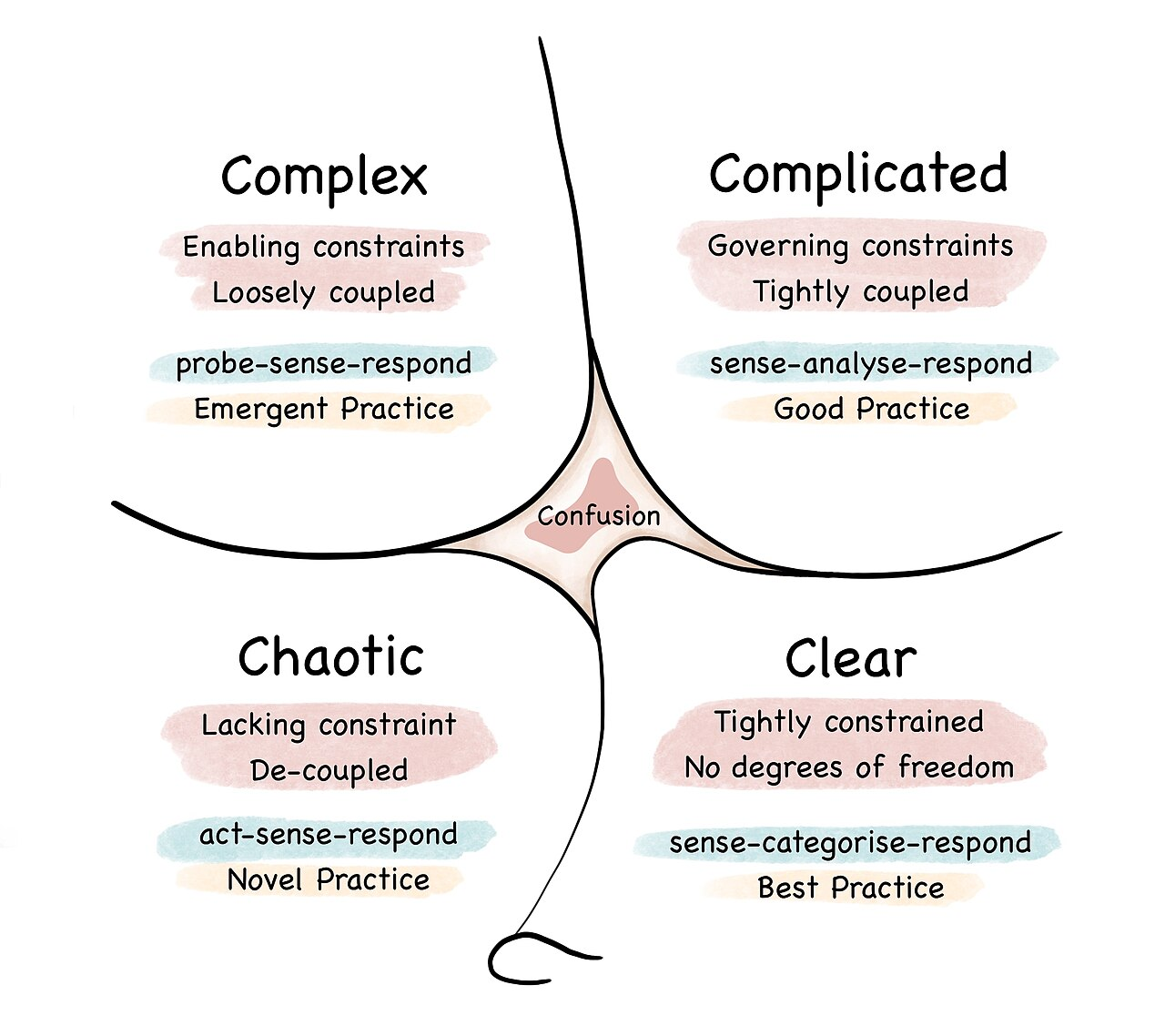
The strategic goal for daily life is simple: actively migrate recurring routines from the Complicated domain into the Clear domain.
By designing robust Standard Operating Procedures (SOPs) for daily logistics, you expand your "Clear" zone:
- Wardrobe & Meals: Automate or batch your daily meals and clothing choices so you never expend conscious deliberation on them.
- Digital Decluttering: Aggressively streamline physical belongings, desktop clutter, and digital notifications.
- Focus Preservation: Concentrate your deep energy on one or two high-resonance projects, leaving structured buffer time for open exploration.
When recurring routines run on auto-pilot, your prefrontal cortex remains pristine for genuinely Complex and Complicated intellectual challenges.
Layer 3: The Tri-State Operating Engine (Thermal Throttling Analogy)
Modern computing architectures never run a processor at 100% clock speed indefinitely; when thermal limits are approached, the system dynamically scales fan speeds and throttles execution to protect silicon integrity.
Human beings require the exact same multi-state operational discipline:
flowchart TD
    %% Layer 1: Cognitive Boundary Control & Input Offloading
    subgraph Layer1 ["1. Cognitive Boundary Control & Micro-Decision Offloading"]
        A["Biochemical & Cognitive Constraints<br/>• lPFC Glutamate Accumulation<br/>• Limited Attentional Bandwidth"] --> B["Micro-Decision Offloading & Routine SOPs<br/>• Decluttering & Minimalist Routines (Meals, Wardrobe)<br/>• Task Automation & AI Assistant Delegation"]
    end

    %% Layer 2: Tri-State Operating Engine & Fail-Safe Architecture
    subgraph Layer2 ["2. Tri-State Operating Engine & Fail-Safe Architecture"]
        B --> C{"System Load Assessment<br/>(Metabolic & Cognitive Load)"}

        C -- "Nominal Load (70%)" --> D["Normal Operation Mode (70%)<br/>• Deep Research & Creative Synthesis<br/>• 30% Buffer for Uncertainty & Flexibility"]

        C -- "High Demand Sprint (110%)" --> D_Full["Full-Speed Mode (110%)<br/>• Critical Deadlines & High-Stakes Projects<br/>• Strict Time Boxing to Avoid Thermal Runaway"]

        C -- "Metabolic Overheating / Burnout Precursor" --> E["Degraded / Fail-Safe Mode (40%)<br/>• Minimum Viable Routine (Sleep, Nutrition, Light Walking)<br/>• Restrict to Procedural SOPs; Halt Heavy Computing"]

        D_Full --> E
        E --> F["Active Thermal Dissipation & Reset<br/>• Clear Synaptic Metabolites (Zero Sensory Overload)<br/>• Somatic Recovery, Meditation & Passive Downtime"]
        F -. "System Cooled / Energy Restored" .-> D
    end

    %% Layer 3: Zero-Judgment Telemetry & Review Loop
    subgraph Layer3 ["3. Zero-Judgment Telemetry & Recalibration Loop"]
        D --> G["Zero-Judgment Telemetry (Google Sheets / Micro-Logs)<br/>• Track Habit Checkboxes, Energy Charge/Drain & Physical Cues<br/>• Raw Objective Logging; Absolute Zero Self-Blame"]
        D_Full --> G
        E --> G

        G --> H["Periodic System Recalibration<br/>• Weekly/Quarterly Macro Audits (Life Alignment & Priorities)<br/>• Audit Intent vs. Reality Drift"]
        H -. "Tune Decision Thresholds & SOP Parameters" .-> B
    end

    %% Styling
    classDef default fill:#FAFAFA,stroke:#333333,stroke-width:1.2px,font-family:sans-serif;
    classDef highlight fill:#F0F4F8,stroke:#1A365D,stroke-width:1.5px;
    classDef alert fill:#FFF5F5,stroke:#C53030,stroke-width:1.5px;
    classDef fullspeed fill:#FFFBEA,stroke:#D69E2E,stroke-width:1.5px;

    class C highlight;
    class D_Full fullspeed;
    class E,F alert;
1. Normal Operation Mode (70% Nominal Capacity)
This is your standard day-to-day operating baseline. You engage in rigorous creative and analytical work, but you deliberately cap your scheduled commitments at roughly 70% capacity. The unallocated 30% is not wasted time—it is a critical buffer that absorbs unexpected friction, emergent problems, and spontaneous creative insight without sending your system into panic.
2. Full-Speed Mode (110% Overclocked Sprint)
Reserved exclusively for high-stakes deliverables, imminent launch windows, or genuine emergencies. Like an overclocked CPU, operating in this zone incurs significant metabolic debt. It must be strictly time-boxed (e.g., 24 to 72 hours maximum) with an explicit, pre-planned return to cooling. Pushing 110% indefinitely without a cooling protocol inevitably induces catastrophic thermal shutdown.
3. Degraded / Fail-Safe Mode (40% Recovery State)
When physical exhaustion, illness, or pre-burnout symptoms manifest, shift proactively into Fail-Safe Mode. This is not a failure of character; it is an active engineering maintenance window.
- Halt all heavy intellectual compute.
- Postpone non-critical deadlines.
- Strip your day down to the Minimum Viable Routine (MVR): restorative sleep, basic nourishing food, light walking, and zero sensory overload.
- Allow the prefrontal cortex to clear accumulated metabolites before gradually spinning the fans back up.
Layer 4: Zero-Judgment Telemetry
Most habit-tracking systems collapse because they are over-engineered and weaponized for guilt. When a complex spreadsheet turns red or a 30-day streak breaks, people feel judged, experience shame, and abandon the practice entirely.
Telemetry should function like an instrument panel in an aircraft: purely descriptive, completely neutral, and zero self-blame.
I maintain a minimalist Google Sheet micro-log containing only what is strictly necessary:
- Date
- Core Binary Habits (Meditation checkbox, exercise checkbox)
- Energy State (Charging activities vs. discharging drains)
- Somatic Cues (Body sensations, perceived fatigue levels)
- Freeform Notes (Observations, emergent ideas)
There is no pressure to fill in every cell every day. If a few days go unrecorded during a demanding sprint, it is simply treated as a missing data point, not a moral failure.
Macro Recalibration
On a weekly or quarterly basis, step back from daily micro-logs and audit the macro trajectory with two high-level questions:
- Am I living in alignment with the life I genuinely want to build? If not, what systemic friction is getting in the way?
- How should I re-prioritize projects and commitments to become the person I intend to be?
Leveraging AI for Cognitive Offloading
In the modern AI landscape, we have unprecedented leverage to offload repetitive cognitive friction.
Rather than burning prefrontal glucose on administrative drafting, text formatting, multi-step scheduling, or structuring raw notes, delegate these tasks to personal AI agents. For a modest monthly subscription, you effectively employ an executive assistant that handles low-level cognitive grunt work, preserving your finite attentional bandwidth for core architectural thinking, creative synthesis, and genuine human connection.
Conclusion: Key Takeaways
- You are an organic engine, not an industrial machine. Respect your biological limits; neural fatigue is an evolved protective circuit-breaker, not a character flaw.
- Micro-decisions cannibalize macro-focus. Ruthlessly automate routine logistics into the Clear domain with SOPs before they pollute your prefrontal cortex.
- Fail-safe is an architectural feature, not a moral defeat. Proactively downclock to 40% when telemetry flashes yellow, rather than crashing into the wall at 110%.
- Less theory, zero self-blame. Build your minimalist telemetry sheet, define your operational modes, and calibrate as you go.
References & Related
- Wiehler, A., Branzoli, F., Adanyeguh, I., Mochel, F., & Pessiglione, M. (2022). A neuro-metabolic account of why daylong cognitive work alters the control of economic decisions. Current Biology, 32(17), 3564–3575.
- ScienceDaily (2022). Why thinking hard makes you tired.
- Inzlicht, M., & Schmeichel, B. J. (2012). What is ego depletion? Toward a mechanistic revision of the resource model of self-control. Perspectives on Psychological Science, 7(5), 450–463.
- Engber, D. (2016). Everything Is Crumbling: An influential theory in psychology may have just been debunked. Slate.
- Snowden, D. J., & Boone, M. E. (2007). A Leader's Framework for Decision Making (The Cynefin Framework). Harvard Business Review.